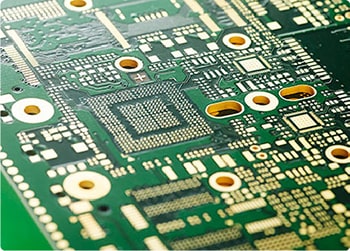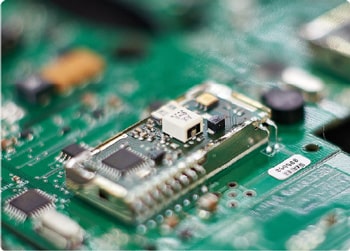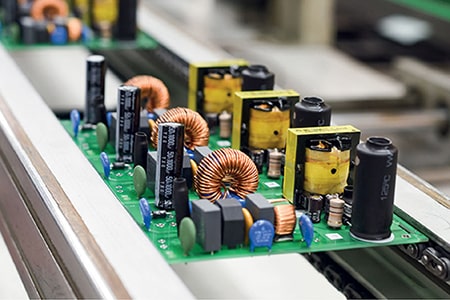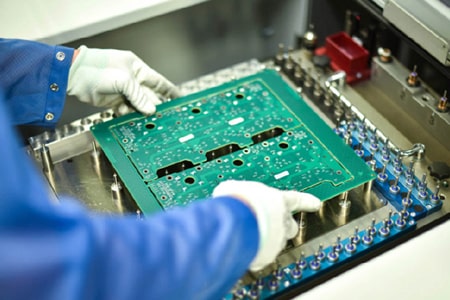
Impedance control (EImpedance Controlling), there will be a variety of signal transmission in the conductors in the circuit board, to increase its transmission rate must increase its frequency, if the line itself due to etching, stack thickness, wire width, and other different factors, will The impedance is worth changing, and the signal is distorted. Therefore, the impedance value of the conductor on the high-speed circuit board should be controlled within a certain range, called “impedance control”.
The impedance of the PCB trace will be determined by its inductive and capacitive inductance, resistance, and conductance. The main factors that affect the impedance of the PCB traces are the width of the copper line, the thickness of the copper line, the dielectric constant of the medium, the thickness of the medium, the thickness of the pad, the path of the ground line, and the traces around the trace. PCB impedance ranges from 25 to 120 ohm.
In practical situations, PCB transmission lines usually consist of a wire trace, one or more reference layers, and insulating materials. Traces and slabs constitute the control impedance. PCB will often adopt a multi-layer structure, and the control impedance can also be constructed in various ways. However, no matter what method is used, the impedance value will be determined by its physical structure and the electronic properties of the insulating material:
Width and thickness of the signal trace Height of the core or pre-filled material on both sides of the trace Configuration of traces and slabs Insulation constant of core and pre-filled material
Impedance-controlled routing begins with the schematic. While design engineers specify their controlled impedance signals’ values and types, we use your design data and manufacturing drawings, as well as our DFM tools and experience, to validate your design against the requested board materials. We work with you to ensure that the target impedance values are within the specified range.
To ensure that the same impedance values are maintained throughout the length of a controlled trace, we take into account the following parameters:
Trace geometry
Signal spacing
Dielectric material
PCBAMake manufactures controlled impedance PCB (printed circuit board) using the latest materials and technology. We have full strict Incoming Inspection (IQC) for all laminates, pre-preg and copper foil, since raw materials’ thickness variances are some of the main challenges for producing controlled impedance PCBs.
Having validated the design, we manufacture the board, getting as close as possible to the target impedance. We also undertake extensive TDR testing to determine that the impedance is within the specified limits. Essentially, a TDR applies a quick electrical step signal to the coupon via a controlled impedance cable and a specialized probe to connect to the pads. If there is a change in impedance value, part of the signal power is reflected back to the TDR instrument. The time delay between the transmitted pulse and the receipt of the reflected signal is proportional to the distance of the discontinuity.
We also use LDI (laser direct imaging) equipment that eliminates the variances in trace width, once a controlled impedance board is imaged, it must go into the etcher. The purpose is to develop a configuration on an etcher to minimize undercut.
Through our 2 hours rapid response services from our 24/7 sales and tech support team, and excellent after-sales service, we will be your best controlled impedance PCB manufacturer & supplier in China. At PCBAMake we can answer any controlled impedance PCB questions that you may have, please feel free to contact us anytime.