










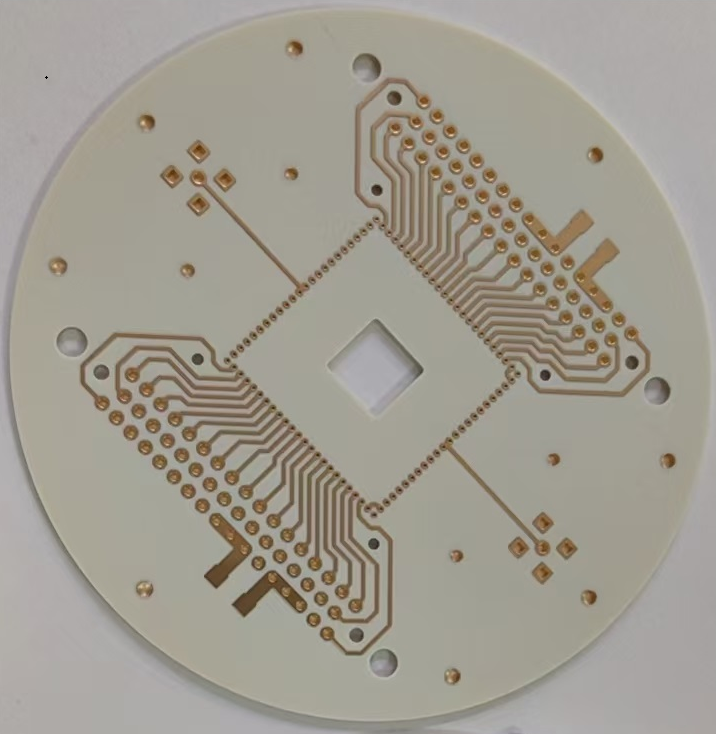
Rogers RO4835 and Rogers RO4350B are both trusted hydrocarbon ceramic laminates from the Rogers 4000 series. Engineers regularly specify them for high frequency RF PCB fabrication, as both feature identical core electrical parameters at 10GHz. This similarity often leads to confusion during stackup design and material selection. While their baseline signal performance appears identical, raw material formulation, oxidation tolerance, and long-term thermal reliability differ significantly. Selecting the wrong grade rarely improves circuit performance; instead, it often introduces hidden oxidation defects and gradual signal drift during prolonged high-frequency operation.
From an electrical perspective, these two Rogers high frequency PCB materials deliver nearly identical performance under standard test conditions. Both achieve a Dk of 3.48 and a Df of 0.0037 at 10GHz. Their thermal expansion profiles also align closely, with X/Y-axis CTE values of 14/16 ppm/°C and a Z-axis CTE of 32 ppm/°C. For standard RF layouts, this consistency ensures reliable impedance control and thermal stress tolerance. It performs sufficiently for most consumer-grade, short-lifecycle hardware. In these basic scenarios, designers cannot distinguish between the two materials through electrical testing alone.
The practical performance gap lies in oxidation resistance and long-term thermal stability. RO4350B is a field-proven, cost-efficient material designed for general commercial RF applications. It meets standard IPC thermal cycling criteria but contains no specialized anti-oxidation chemistry. Over time, prolonged high-heat exposure gradually degrades its internal resin structure. In contrast, RO4835 high stability RF substrate adopts a proprietary modified formula. Its oxidation resistance is approximately 10 times higher than that of traditional thermoset high-frequency laminates. This upgrade effectively prevents gradual inner-layer degradation and surface discoloration, common failures in long-running high-power circuit boards.
This chemical difference results in vastly different field reliability outcomes. RO4350B performs best in cost-sensitive products with intermittent medium-frequency operation. Typical applications include consumer WiFi 6E modules, general IoT RF transceivers, and civilian broadband PCBs. Thanks to its mature supply chain and forgiving process window, it remains the top choice for high-volume commercial RF microwave PCB production. However, it has distinct limitations. Under sustained high temperatures and high power density, RO4350B exhibits noticeable aging. Circuit loss increases slowly, and signal repeatability deteriorates after thousands of operating hours.
RO4835 high frequency PCB substrate precisely addresses this reliability gap. It is engineered for continuous-duty industrial environments where long-term material stability is critical. Its enhanced anti-oxidation structure maintains stable Dk and Df values through rigorous thermal cycling tests. Even after repeated thermal shocks and long-duration high-power operation, electrical loss remains consistent with minimal drift. This superior reliability makes it indispensable for high-end precision hardware. It is widely applied in 5G micro base station radio units, 77GHz automotive radar sensors, and industrial millimeter-wave detection equipment that requires decade-long stable performance.
Manufacturing characteristics further differentiate the two materials. Both laminates are fully compatible with standard FR-4 lamination, drilling, and etching workflows, eliminating the need for specialized PTFE-style plasma processing. RO4350B offers a much wider process tolerance. It is easier to calibrate during mass production and delivers higher batch yields under standard factory parameters. RO4835 requires tighter temperature and pressure control during lamination and reflow to preserve its anti-oxidation properties. Though its processing cost is slightly higher, it significantly reduces field failures caused by material aging and oxidation. For high-reliability projects, it delivers far better lifecycle value.
Material selection ultimately depends on project operating conditions and reliability targets. For cost-focused consumer devices with short service lifespans, Rogers RO4350B PCB material delivers fully adequate and cost-effective performance. For outdoor telecom infrastructure, automotive radar systems, and industrial high-power RF devices requiring long-term thermal stability and oxidation resistance, RO4835 serves as a safer, upgraded solution. Understanding these practical differences helps designers avoid over-specification or risky under-design in critical high-frequency PCB stackup designs.
Rogers RO4835 Full Performance Specification Table
The table below covers verified industrial-grade parameters ofRO4835 high stability RF substrate. All typical values follow official Rogers datasheet standards and common ASTM/IPC test methods, supporting high-frequency PCB simulation, stackup design and mass production validation.
|
Parameter Category
|
Technical Property
|
Typical Value
|
Test Condition & Standard
|
Unit
|
|---|---|---|---|---|
|
Electrical Properties
|
Process Dielectric Constant (Dk)
|
3.48 ± 0.05
|
10GHz, 23℃
|
–
|
|
Design Dielectric Constant (Dk)
|
3.66
|
8GHz – 40GHz broadband
|
–
|
|
|
Dissipation Factor (Df)
|
0.0037
|
10GHz, 23℃
|
–
|
|
|
Thermal Coefficient of Dk (TCDk)
|
+50
|
-50℃ to 150℃
|
ppm/℃
|
|
|
Volume Resistivity
|
5×10⁸
|
ASTM D257, room temperature
|
MΩ·cm
|
|
|
Thermal Properties
|
Glass Transition Temperature (Tg)
|
280
|
DSC test
|
℃
|
|
Decomposition Temperature (Td)
|
390
|
TGA thermal stability test
|
℃
|
|
|
Thermal Conductivity
|
0.66
|
50℃, ASTM D5470
|
W/m·K
|
|
|
CTE (X/Y/Z-axis)
|
13 / 15 / 46
|
-55℃ to 288℃
|
ppm/℃
|
|
|
Physical Properties
|
Water Absorption
|
0.05
|
D48/50 standard test
|
%
|
|
Dimensional Stability
|
<0.5
|
Etched + 150℃ aging, IPC-TM-650
|
mm/m
|
|
|
Mechanical Property
|
Tensile Modulus (Y-direction)
|
9310
|
ASTM D638, room temperature
|
MPa
|
Parameter Note: RO4835 retains consistent Dk/Df performance across wide frequency and temperature ranges. Its ultra-high Tg and upgraded anti-oxidation formula effectively suppress thermal aging and signal drift, making this high oxidation resistance Rogers PCB material ideal for long-cycle 5G base stations and 77GHz automotive radar high-frequency applications.